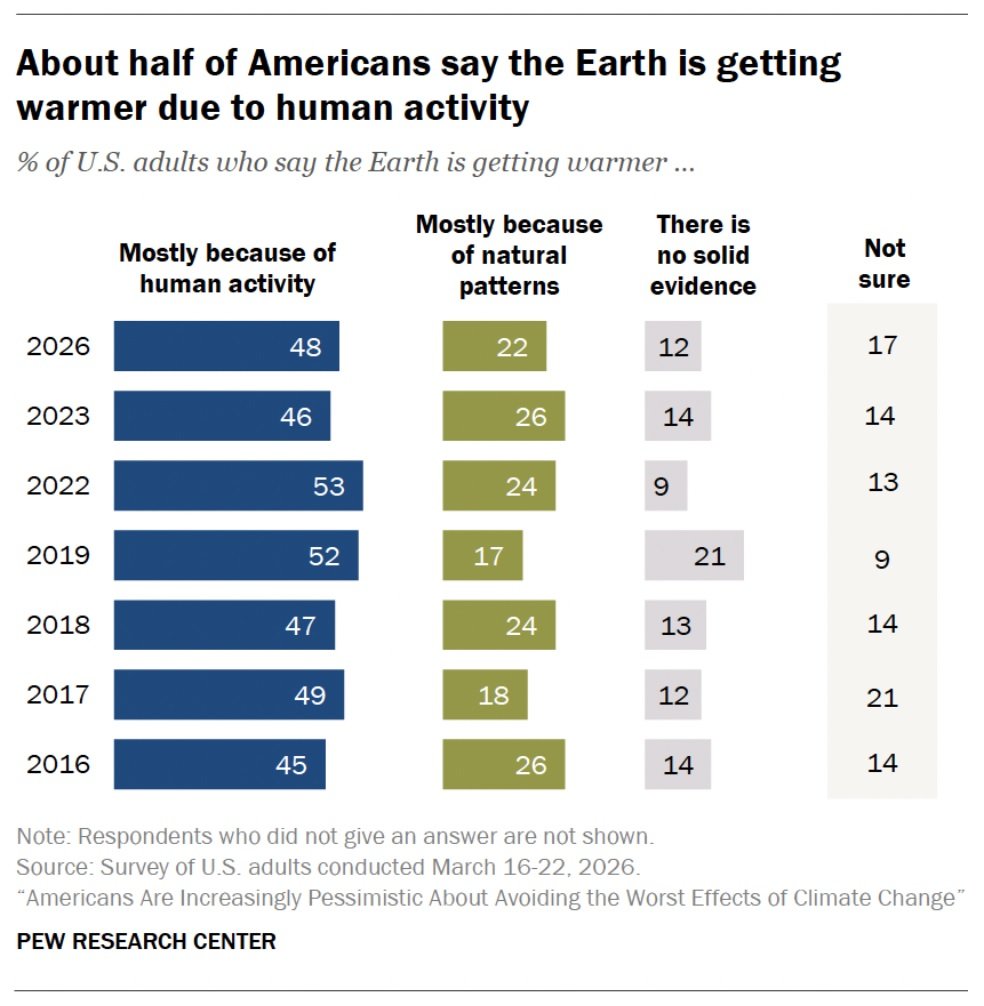
The latest Pew Research Center survey of Americans’ views on climate change shows that about half of Americans believe the Earth’s warming is caused by human activity (48%) – a number that has had very little variation over the past decade. The rest believe that climate change is either a natural phenomenon (22%) or that there’s no solid evidence the planet is warming (12%). The remainder just aren’t sure what to believe (17%).
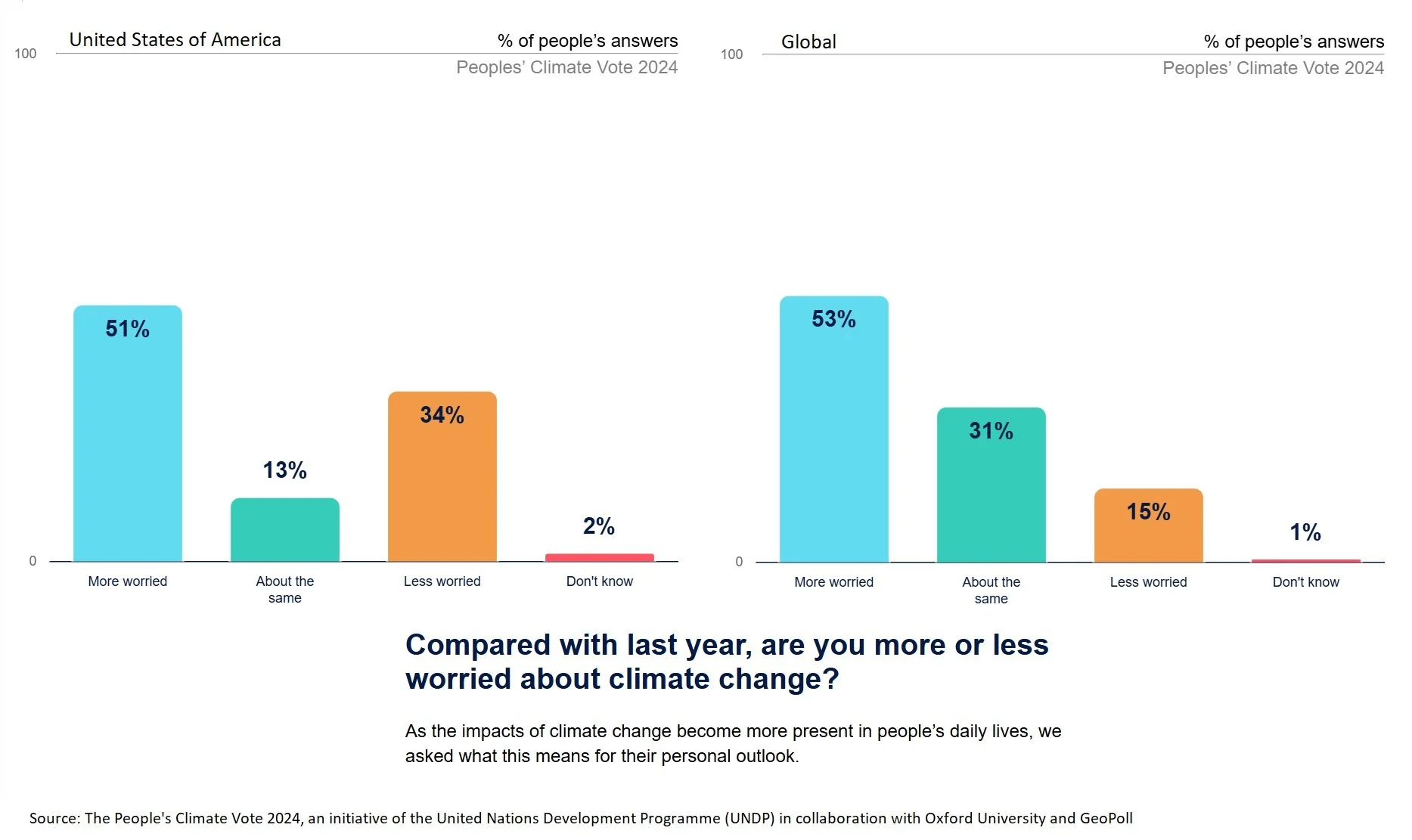
These numbers are especially striking given that nearly all climate scientists view climate change as a mostly human created problem, with those having the highest levels of expertise reaching 100% agreement. Americans are also an outlier in comparison to their global peers. For example, the results of the United Nations Development Programme and Oxford University’s 2024 Peoples’ Climate Vote show that 34% of Americans are LESS worried about climate change now than they were last year. Meanwhile, the results of the global survey (which includes US respondents) show that only 15% of those surveyed worry less now.
So why don’t Americans believe in climate change – and worry about it – as much as people in other parts of the world?
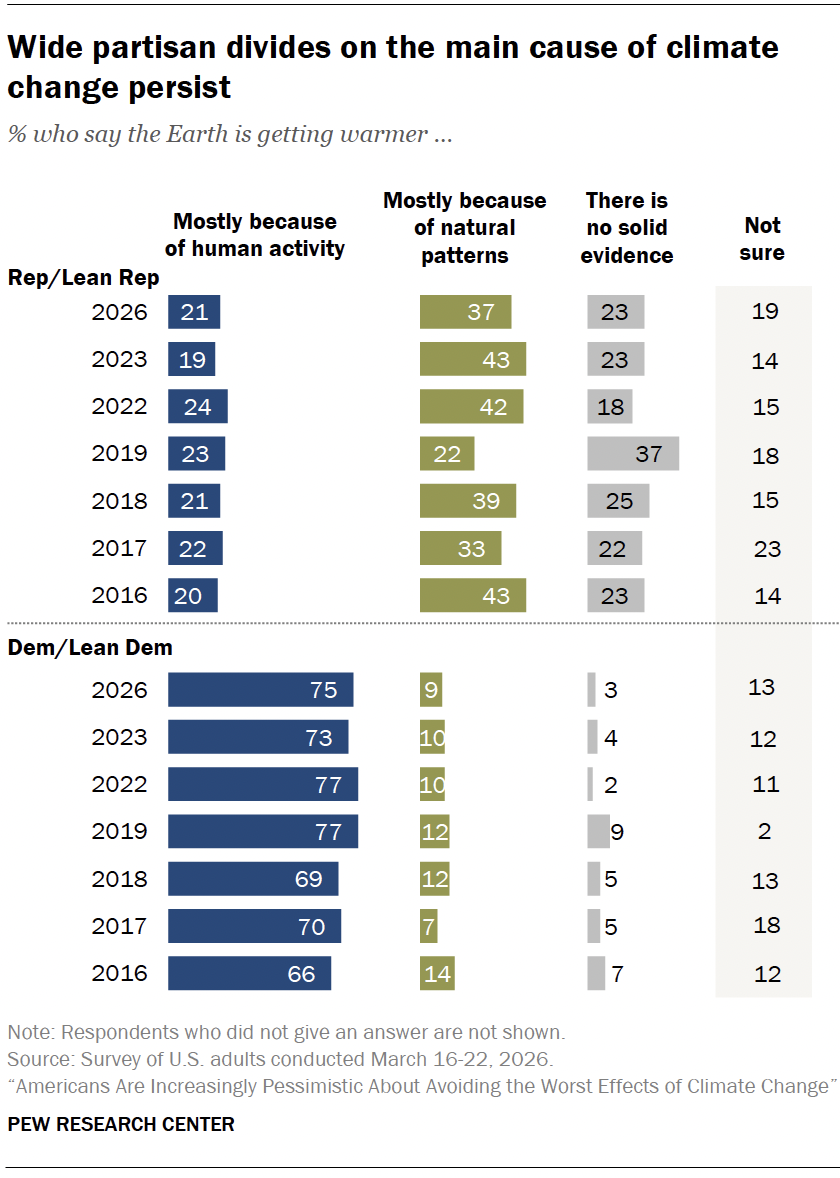
There are a number of reasons and plenty of research on this, but the cause that most interests me has to do with politics. If we go back to the Pew Research Center’s survey, we can see that accounting for political party drastically shifts the numbers. For example, in 2026’s survey, 75% of Democrats and those who lean Democrat believe that the Earth is getting warmer mostly because of human activity. In contrast, only 21% of respondents who identified as Republican or Republican leaning hold the same belief. That is a huge gap!
Belief in human caused global warming is a highly political issue in the US. So how did it get this way?
Again, there are a number of causes (see Naomi Oreskes and Erik M. Conway’s excellent book, Merchants of Doubt, on the tactic of scientists-for-hire) but the one I think isn’t talked about enough – and probably lots of people don’t know about – is the use of corporate front groups that peddle climate change disinformation.
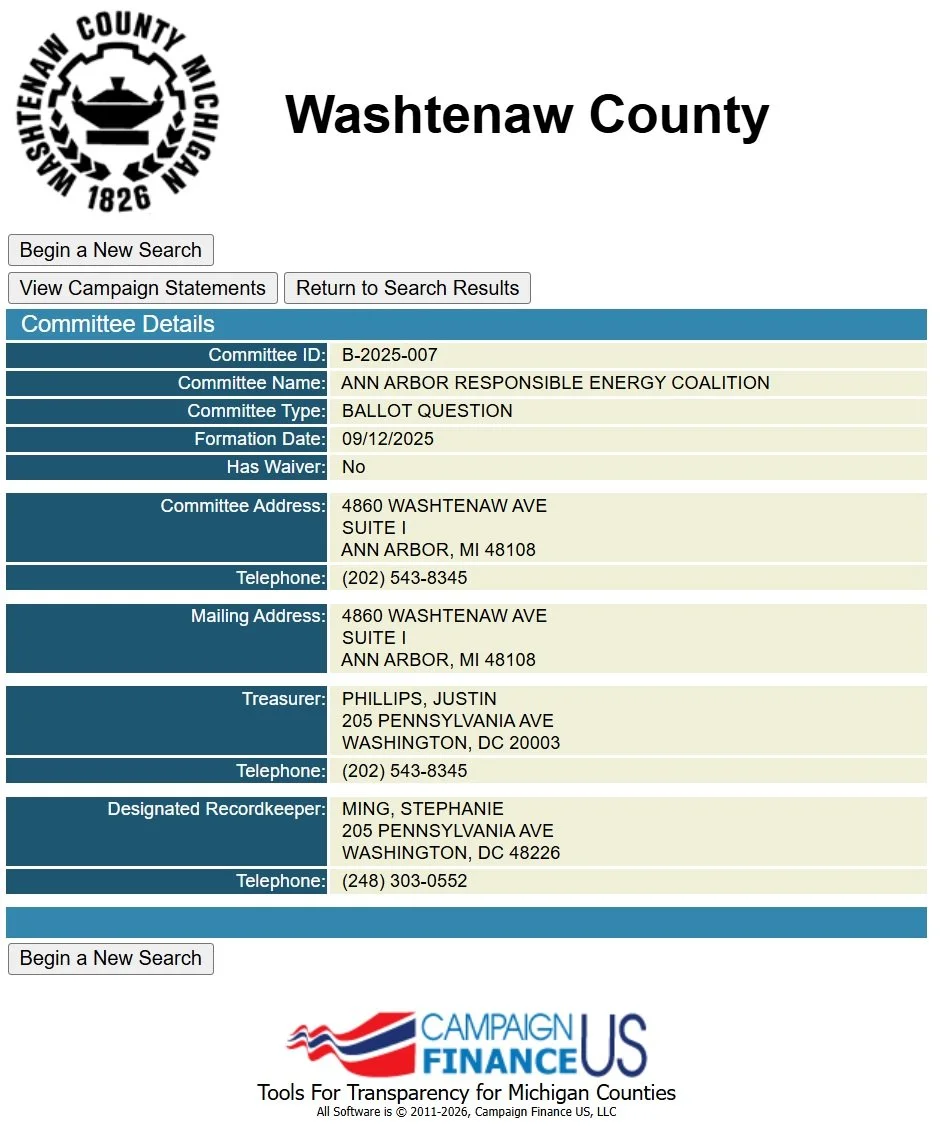
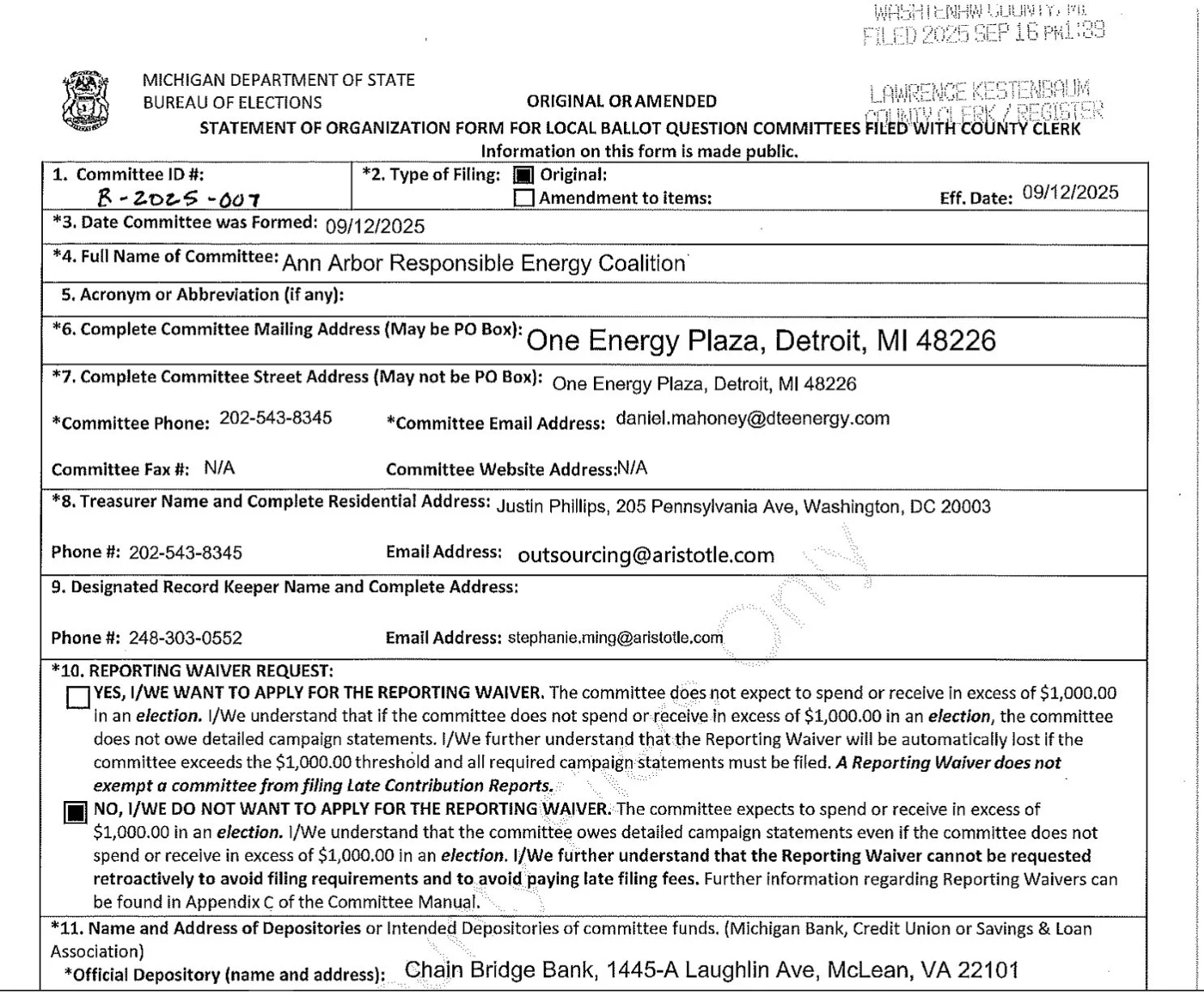
Corporate front groups – civil society organizations that are formed, funded, and/or co-opted by corporations to advance their interests while obscuring their firm ties – have long been a favored tactic of industries trying to prevent action on climate change. The fossil fuel industry is perhaps the guiltiest of the guilty in using this tactic. Between 1997 and 2015, ExxonMobil alone was found to have spent over $33 million supporting organizations that spread climate disinformation, many of which were corporate front groups For example, the Institute for Energy Research (IER) received at least $337,000 from Exxon in addition to taking money from the American Petroleum Institute and several Koch family connected organizations. Besides spreading climate disinformation, IER engaged in numerous efforts to block legislation combatting climate change, including a campaign “to put the final nail in the coffin of the carbon tax” (Benjamin Cole, communications director for IER) proposed during the Obama administration.
One of the most impactful front groups blocking climate action and spreading disinformation is the American Legislative Exchange Council (ALEC), which receives nearly all of its funding from corporations and the foundations of corporate founders, like the Koch brothers and the Coors family. For more than 50 years, ALEC has been selling itself as a center for model legislation, bringing together conservative lawmakers and corporate interests to create and distribute draft legislation for US states. In 2002, The Natural Resource Defense Council described ALEC as “Corporate America’s Trojan Horse.” In 2014, the American Bar Association published an expose on ALEC, claiming the organization had “undermined Americans’ civil rights, civil liberties, and human rights in numerous ways.” If you want a deep-dive on all of ALEC’s ill deeds, The Center for Media and Democracy has a fantastic wiki called ALEC Exposed.
To see ALEC in action, let’s look at its campaign to block the Environmental Protection Agency (EPA) from being able to regulate greenhouse gas emissions. On September 11th of 2008, ALEC’s Board of Directors voted to approve its Resolution in Opposition to EPA’s Plan to Regulate Greenhouse Gases Under the Clean Air Act. Incidentally, ALEC’s board is full of corporations and has included Exxon, Koch Industries, Peabody Energy, and Energy Future Holdings. By 2011, Indiana had passed a resolution asking Congress to prevent the EPA from regulating greenhouse gas emissions. A few months later, 13 states had also passed resolutions asking the same thing, and an additional six other states introduced similar resolutions that failed to pass. While ALEC was not successful in preventing the EPA from regulating greenhouse gases (the EPA’s 2009 Endangerment Finding on greenhouse gases allowed some regulation, until emissions standards were repealed in 2025 under the Trump administration), it did succeed in getting its model resolution passed in 14 US states.
Other successful anti-climate ALEC efforts include keeping the US out of the Kyoto Protocol during the George W. Bush administration, blocking “Sons-of-Kyoto” legislation in US states like Illinois and New York, and drafting model bills to increase “fracking,” nuclear energy, and offshore drilling. ALEC is also behind more recent efforts to ban states from contracting with businesses that divest from fossil fuel companies, with bills successfully passing in Texas, Alabama, Arkansas, Idaho, and Utah (note, many of these are being challenged in the courts). If you’ve ever heard politicians extol the safety and necessity of fossil fuels, deride the possibilities associated with renewable energy, or rail against the existence of climate change, there’s a good chance they were drawing on talking points from ALEC.
There are way too many corporate front groups spreading climate disinformation to discuss them all in one piece – a good portion of the 300+ front groups in my data base engage in climate change denial. Luckily, there are many wonderful organizations doing deep dives and tracking these organizations, many of which I’ve linked above. Some others to check out include Mother Jones’s Dirty Dozen of Climate Denial (includes front groups, companies, and individuals), DeSmog’s Climate Disinformation Database and its Koch Network Database, and the Center for Media and Democracy’s SourceWatch wiki on Front Groups (not all are into climate change denial, but many are).
Given the tens, if not hundreds of millions of dollars that corporate and wealthy elite interests have poured into convincing legislators and their constituents that climate change is not real, that fossil fuels are the future of America, and that there’s no need for renewable energy, is it any surprise that so many Americans don’t believe that our warming planet is a human-caused phenomenon?
Americans have been inundated with decades of propaganda (scientists first warned the President about the dangers of climate change more than 60 years ago) designed to make us doubt whether climate change is real. At the same time, corporate front groups have catastrophized the impacts of climate change interventions, warning of economic collapse and the loss of the American way of life. Why take action on something you’re not even sure is real if it could cause so much damage?
If we want more Americans to believe climate change is real and caused by human activity, we have to divorce the issue from politics and make it a bipartisan effort (like the hole in the ozone in the 1980s). A big part of doing that will require stopping the flow of money from the fossil fuel industry and other corporate interests and silencing their corporate front group puppets.
Without these changes, we’re likely to face another decade where only half of Americans think global warming is something humans can and should stop.