In honor of Earth Day, let’s take a look at the two main ways that corporations use front groups to prevent or slow progress on environmental issues.
The first is through direct opposition to environmental efforts, usually by obstructing new laws and regulations or rolling back existing ones. The second method of environmental opposition is much more insidious. By creating front groups that look like authentic environmental organizations, corporations can manipulate both public opinion and the decisions of policymakers through the use of disinformation about their focal environmental issues.
Let’s dive deeper into each type of corporate front group strategy and look at some examples of how they operate.
Environmental Direct Opposition Front Groups
Corporate front groups that directly contest environmental laws or regulations tend to be quite open about their opposition. What they are more secretive about is who is behind their efforts and why they’re trying to influence constituents and policymakers.
One example is Citizens for Sensible Control of Acid Rain (CSCAR), which was operational between 1983 and 1991. The group was open about its opposition to legislative efforts to reduce acid rain – it ran a major campaign to stop the Acid Rain Control Act of 1986. The group spent $3,028,235 on lobbying against the bill that year (more than nine million dollars in today’s money), earning the dubious honor of having spent more money on lobbying than any other organization in 1986.
Most of that money went to a mail campaign. The organization called constituents and used a script asking them if they agreed that $100 billion was too much money for the government to be spending on addressing the issue of acid rain. With that very specific phrasing, many people said yes. The CSCAR caller would then ask if the constituent would like to send a mailgram to their Congressperson to let them know that they opposed the bill. Constituents that said yes would then be offered a pre-written letter that would be sent on their behalf – you know, because they’re surely busy and CSCAR would love to help them out.
CSCAR also ran a mail campaign targeting constituents, sending nearly a million packets claiming that the acid rain bill would raise electricity costs for consumers by 30 percent. The packets also had pre-addressed envelopes and a letter with the constituent’s name and address printed across the top that could be sent to the constituent’s congressperson to voice their opposition to the bill. House staffers that received them said that there were at least 17 versions of the letters, which was done to aid in concealing their source.
CSCAR presented itself as an organization of citizens taking action to ensure that government doesn’t misappropriate taxpayer money by enacting an overzealous acid rain control bill. But who was really behind CSCAR and what were they actually trying to achieve?
Nearly all of CSCAR’s money came from electric utilities and coal companies, including the top two coal producing firms in the country. Thomas Buckmaster, Executive Director of CSCAR, was also a senior partner at the public relations firm Fleishman Hillard, Inc. And the 150,000 volunteers CSCAR claimed to have was just anyone that agreed to send a letter or call their Congressperson. The Sierra Club and the National Audubon Society issued a statement about CSCAR in which they called it “a nice sounding front group for a bad bunch of polluters.”
CSCAR’s actual goal was to block any acid rain control legislation that would increase costs for its main donor – the energy industry. And they were successful. Despite more than 170 House members cosponsoring the 1986 bill, it ultimately failed when it died in the Committee on Energy and Commerce. CSCAR was also instrumental in preventing an acid rain bill in 1984 from making it out of committee for a full vote. In fact, CSCAR was a driving force in preventing the passage of any acid rain legislation until 1990’s Clean Air Act Amendments.
A 2012 report found that after acid rain control was finally implemented, SO2 emissions (one of the main causes of acid rain) dropped by 64% between 1990 and 2009. Citizens for Sensible Control of Acid Rain successfully kept the US suffering the effects of acid rain for an extra six years.
Imitation Environmental Front Groups
In contrast to corporate front groups that engage in direct opposition, front groups that imitate environmental activist or advocacy organizations often use subtler tactics to shape public opinion and public policy. These organizations present themselves as authentic environmentalists advocating for changes that will protect the environment, making it harder for their targets to assess the validity of their claims.
A classic example is the Save Our Species Alliance, which portrayed itself as a group focused on improving the Endangered Species Act to save more animals. In reality, the organization was run by a PR firm with lumber industry clients that wanted to gut the Endangered Species Act (you can read more about SOSA here).
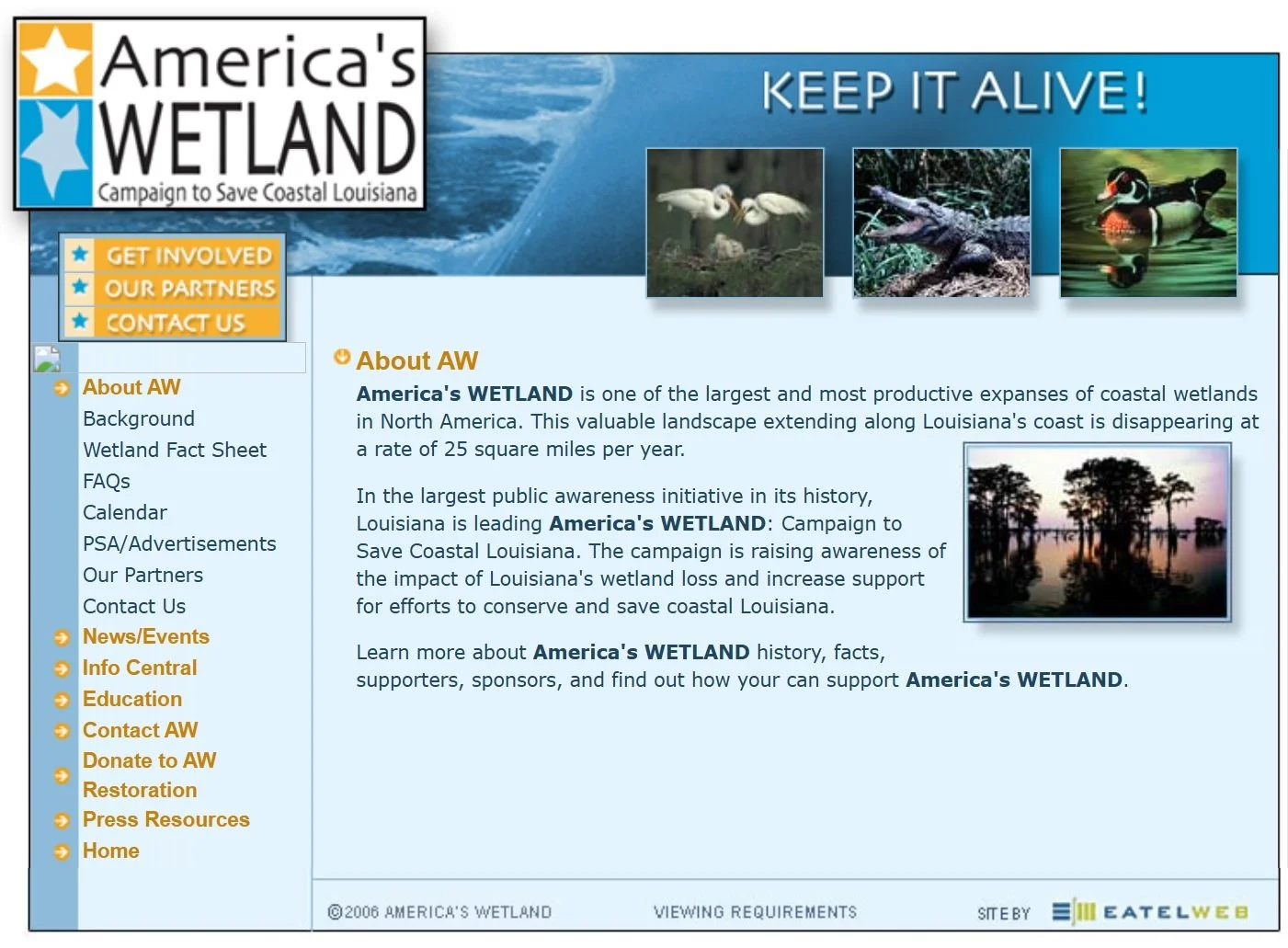
Screenshot of America’s WETLAND Foundation’s website captured on March 16, 2006. Source: https://web.archive.org/web/20060316061518/https://www.americaswetland.com/custompage.cfm?pageid=2
While many imitation environmentalist front groups are basically shell organizations – like the Save Our Species Alliance - some have physical locations and staff, which can make it even harder to identify their true motives. One example is the organization called America’s WETLAND Foundation (AWF).
AWF was founded in 2002 with funding from the oil industry, including Shell and BP. The organization got its start in 2001 as a project of former Louisiana Governor Mike Foster aimed at combatting coastal erosion. It was intended as a public awareness campaign to rally support for securing federal funding to cover the more than $14 billion needed to restore Louisiana’s coast. It became a fully independent organization in 2003.
For years, AWF walked the line between calling for wetlands restoration and advocating for fossil fuel extraction. Throughout their website, the economic importance of oil and gas and its ties to wetland areas is subtly mentioned alongside facts about the importance of wetland habitats. This can be seen in text from AWF’s FAQ section on their website in 2003:
“What will it cost to restore the wetlands?
Restoring coastal Louisiana will cost upwards of $14 billion, while it is estimated that the cost of inaction will amount to more than $100 billion in infrastructure alone.
How much oil and gas travels through America’s WETLAND?
One-fourth of all the oil and gas consumed in America and 80% of the nation’s offshore oil and gas travels through Louisiana’s wetlands.
What is the ecological significance of America’s WETLAND?
More than 95% of all marine species living in the Gulf of Mexico spend all or part of their life cycle in Louisiana’s wetlands. Further, Louisiana’s wetlands are the wintering habitat for millions of waterfowl and migratory birds whose habitat is lost as the wetlands disappear.”
AWF largely flew under the radar nationally until 2010 when it launched a campaign aimed at mobilizing Americans to demand that the US government fund the clean up of the BP Deepwater Horizon oil spill. On the surface, that sounds great – until you realize that the very company responsible for the oil spill is a major funder of the organization pushing for the government, i.e. taxpayers, to cover the costs of cleaning it up. The campaign fooled a lot of celebrities, most notably Sandra Bullock who pulled her support as soon as she learned of the organization’s oil industry ties.
The Chairman of AWF (before it shut down) was R. King Milling, who served as President and Vice Chairman of Whitney National Bank and Whitney Holding Corporation, which benefitted from the oil industry. In a speech that Milling gave at Loyola University New Orleans, he made his motives for wetlands restoration clear:
“Over 25% of oil and gas consumed by this country crosses the fragile ecosystem, and without its protection, the complex infrastructure, wells, thousands of miles of pipelines, compressor systems, holding tanks, all essential to delivery shall be at risk, for each structure and every mile of pipe located under that ecosystem was fabricated based upon the inherent protection afforded by our marsh and swamp.”
Miling and the AWF spent nearly two decades working to protect wetlands only to the extent that it benefitted the oil and gas industry while making the case that wetlands and fossil fuel extraction can coexist.
---
In all the cases I mentioned, the thing that stands out the most is the question of who benefits. When you see organizations pushing to block public policy that would safekeep the environment, or seeking to change existing regulations that protect the planet and human health, be suspicious. Look for the money trail. Often it will lead right to a corporation’s door.