Corporate front groups are notoriously tricky to identify – being secretive is kind of their thing. So how do you tell if a group or organization is really a front for corporations, or if it actually is a group of concerned citizens whose interests happen to align with big business?
For many types of front groups, getting a definitive answer can be difficult. Without a whistleblower providing concrete evidence or slip ups from the organization, we often can only speculate. But there is one type of corporate front group where getting the information needed for making a clear-cut identification is relatively easy: Ballot measure committees.
If you live in one of the 24 states that allow constituents to bypass lawmakers and submit their own petitions for a vote, then you’ve probably seen a corporate front group in the form of a ballot measure committee – especially if you live in California. Depending on the state, it may be called a ballot initiative, or ballot measure, or proposition.
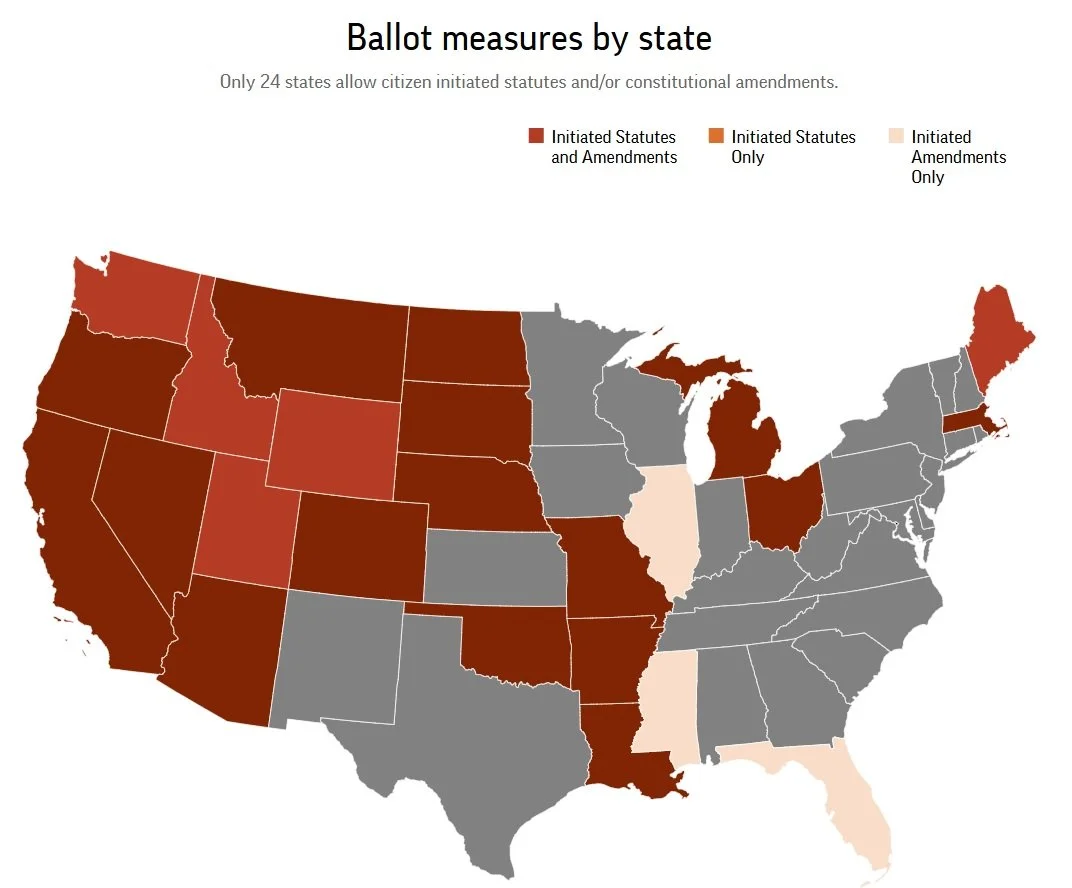
Most (if not all) states that allow ballot measures also have campaign finance rules around the creation and use of ballot measure committees – organizations that campaign for or against a proposed ballot measure. These organizations often have to file paperwork with their respective state to declare themselves as a ballot measure committee and have financial reporting responsibilities. Like political action committees (PACs), ballot measure committees have to regularly report their donors and the amount of their contributions. Luckily for us, most (if not all) states make their campaign finance databases open to the public. Although I would note that some are easier to find and are more user friendly than others.
Ballot Measure Front Groups
What makes a ballot measure committee a front for corporate interests instead of an authentic effort to oppose or support a ballot proposal?
I have an ongoing project tracking corporate front groups that take the form of ballot measure committees. In determining whether to include a committee as a front group, I use two factors: The degree to which the committee is open about its goals or purpose and how transparent it is about its funding.
Ballot measure committees operating above the board will clearly state why they are for or against a ballot proposal and will provide factual evidence in support of their views. They will also openly share who the members of their coalition are and who is funding their efforts. Ballot measure committees operating as corporate front groups do not.
One of the most extreme examples of a ballot measure corporate front group was the organization Californians for Statewide Smoking Restrictions (CSSR). This committee campaigned for the passage of 1994’s California Proposition 188, Public Smoking Ban Initiative. What made this proposition so tricky – its opponents called it a “Trojan Horse” initiative – is that had it passed, it would have actually weakened smoking bans in California, not strengthened them as the name implied. Terry Friedman, a former Democrat State Assemblyman, described Prop 188 as “the most deceptive campaign in my quarter century of close observation of local politics.”
CSSR was actually funded by the country’s top tobacco companies who spent more than $18 million on the campaign. Prop 188 would have set a state smoking ban that would pre-empt much stronger local smoking bans. Essentially, it would have allowed smoking in designated smoking areas in restaurants and employee cafeterias and would permit “smoking in private offices, and business conference rooms with occupants' consent.” Many hospitality and gaming establishments, like bars, bingo halls, racetracks, private boxes in sports facilities, and gaming clubs would have been exempt from the smoking ban. Prop 188 put forth a state-wide smoking ban that actually banned very little – a clear benefit for tobacco companies.
While not all ballot measure committees operating as a front for corporations will be quite so egregious in their use of deceitful tactics, they will generally obscure how they were formed, who is funding the operation, and will often overstate the breadth of their supporters. You’ll see a lot of statements like “we’re a group of small businesses, community members, healthcare professionals, educators, etc.” that attempt to demonstrate a broad base of support, especially from typically trusted groups, without naming specific companies. Or they may name some supporting organizations that give the impression that the group is a grassroots coalition while withholding their corporate supporters. They also may straight up lie, claiming that organizations support them when they do not.
Researching Ballot Measure Front Groups
So how do we use campaign finance databases to identify corporate front groups?
Let’s go step-by-step using an example that has recently been in the news: the Ann Arbor Responsible Energy Coalition (AAREC), an organization opposing a proposal for the City of Ann Arbor to create its own municipal electric utility running 100% on renewable energy, replacing DTE Energy.
We’ll start with AAREC’s website. The first thing to note is that the organization does not have a formal “About Us” section where they disclose who they are, which is our first red flag. If you scroll down far enough, they do have two sentences about “who we are”:
“Ann Arbor Responsible Energy Coalition brings together community members, businesses, and residents who believe there are better, faster, less risky paths to the energy future Ann Arbor wants. We’re not here to defend the status quo — we’re here because the evidence shows this proposal would set Ann Arbor back, not move it forward.”
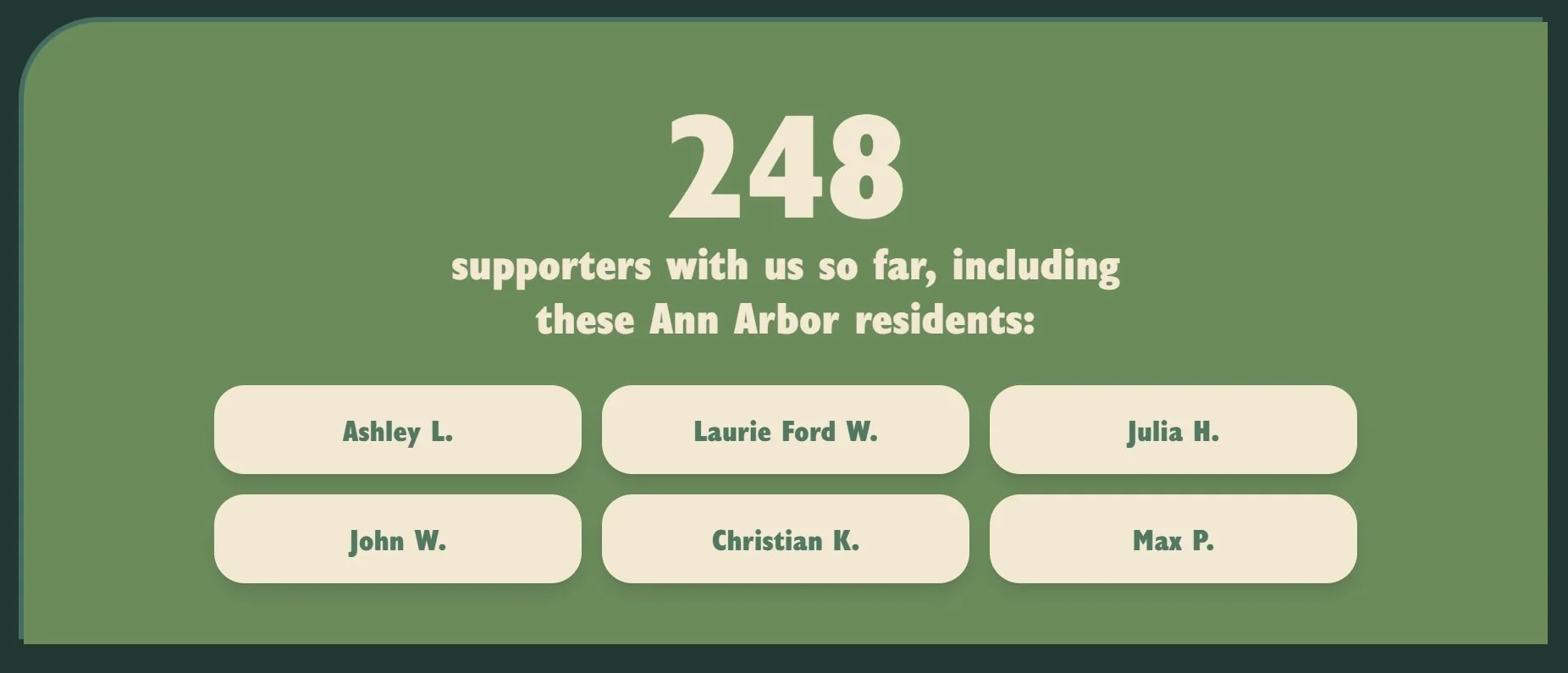
Note the very generic list of types of people and organizations in their coalition. One could argue that community members and residents are synonymous – so they’re basically claiming to bring together businesses and people who live in Ann Arbor. But not a single business is named. The site also lists a handful of purported Ann Arbor residents who are “with us so far” providing first names with last initial. I suspect that if these people are real, they are folks who signed up for the email list, which really could be anyone wanting to keep tabs on the organization – not necessarily coalition members.
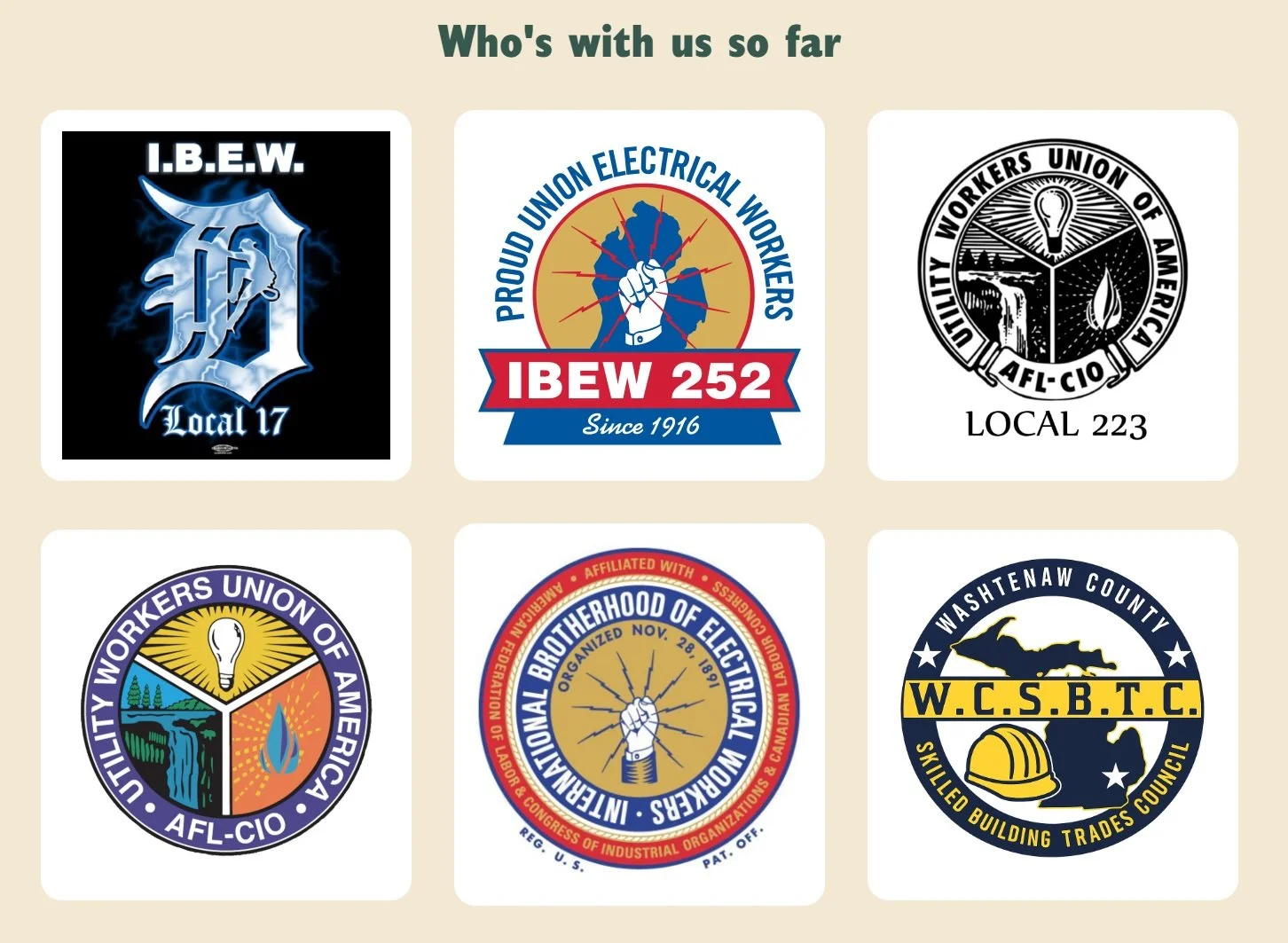
On their Join Us page, AAREC also has the logos of 6 labor unions and labor groups. Two of them are the same – they have a logo for a local chapter and its national organization. I looked at the websites and social media for I.B.E.W. Local 17 and UWUA Local 223 and did not see any statements on the proposal to create a municipal utility in Ann Arbor, nor did I see any mention of AAREC. There is also no evidence, such as joint statements, that I could find on the AAREC website that these labor organizations are AAREC members or supporters. Another red flag.
Now that we’ve found some suspicious patterns on AAREC’s website, let’s look for a paper trail. Since this is a local (not state-wide) ballot initiative, we’ll need to go to the county’s campaign finance website. Because there is no candidate, we’ll use the Search by Committee Name option. It brings up one result and we can click on the More Info link to get more details.
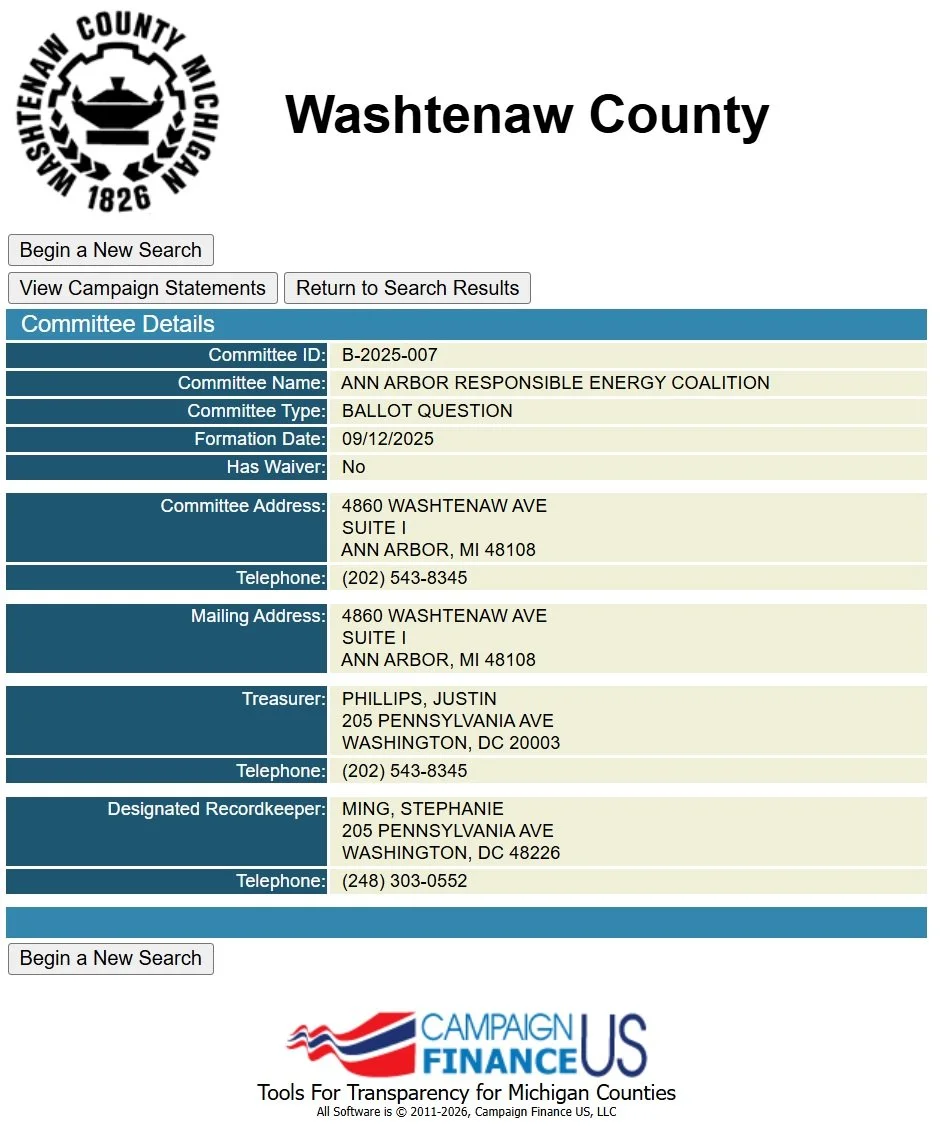
Interestingly, the listed Treasurer and Designated Recordkeeper for AAREC both work for Aristotle, a DC company that offers a variety of campaign finance, lobbying, consulting, and data analysis services for political action committees. AAREC’s currently listed address is in a strip mall. Suite I is a Goin’ Postal franchise location that offers private mailboxes. More red flags.
If we click on View Campaign Statements, it provides us links to a variety of documents that AAREC has filed with the Washtenaw County Clerk since its inception. If we start with the Statement of Organization, we find some very interesting information. The original address for AAREC is One Energy Plaza in Detroit – the headquarters of DTE Energy. The electric utility that directly stands to lose if Ann Arbor forms its own municipal utility. Furthermore, the contact email is for Daniel Mahoney, DTE Energy’s Director of Policy & Regional Affairs (if you search, you can find his LinkedIn profile, but I won’t link it here). We also see that Aristotle was involved in the creation of AAREC from the very beginning.
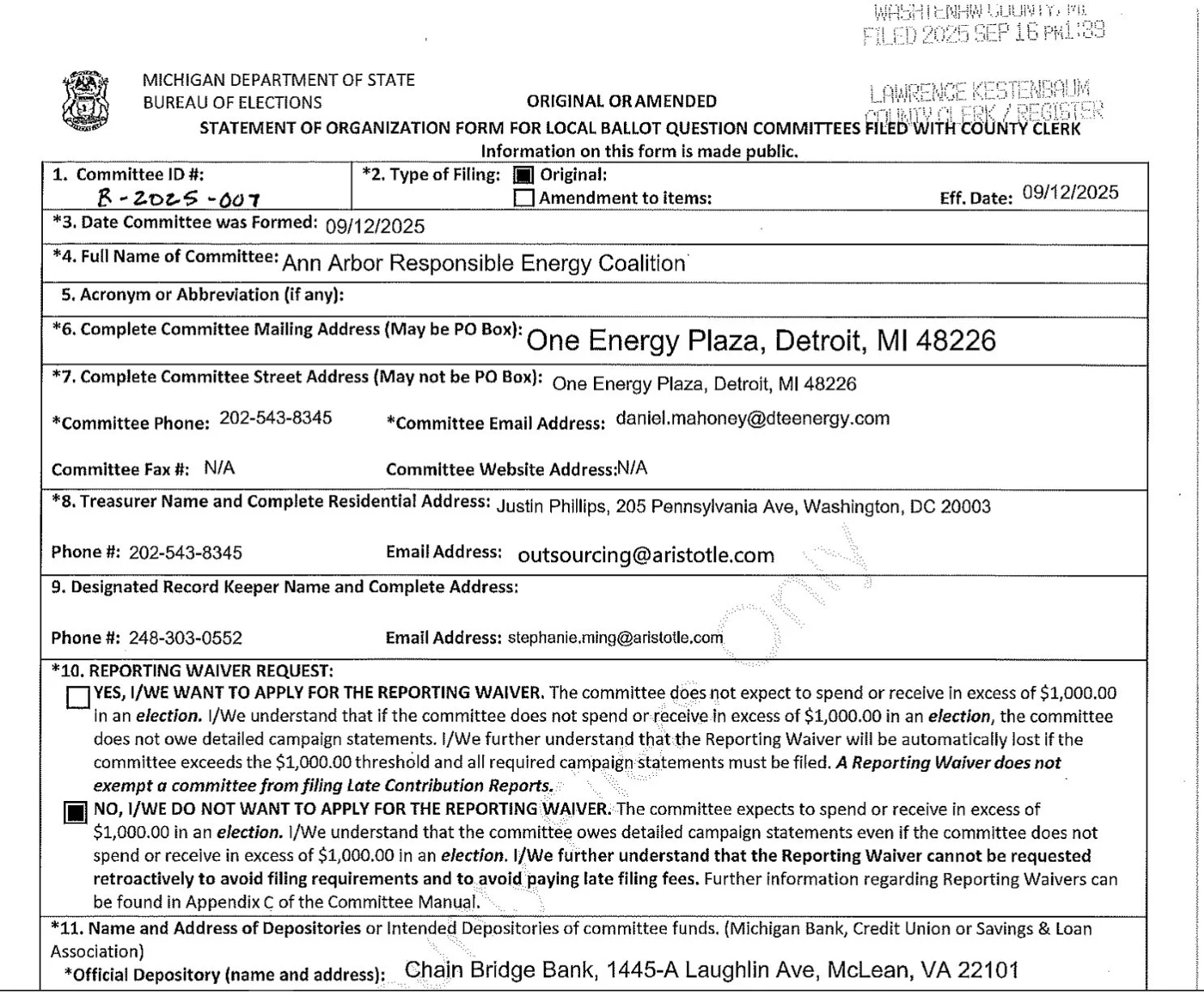
So far there are no Ann Arbor businesses or residents or community members involved in the creation or running of AAREC. A massive red flag.
Let’s look at the money trail. In its first quarterly financial statement, AAREC’s only listed financial contribution is $25,000 from the Edison Electric Institute (EEI) in Washington, DC. EEI is an industry association representing investor-owned electric utilities in the US. This means that EEI works on behalf of DTE Energy and other utilities like it. One way that companies hide their involvement in corporate front groups is by giving money to industry associations who then in turn make donations, obscuring which specific companies are involved. The statement also has a $600 in kind contribution from DTE Energy for “Employee Salary – FMV.” I suspect this means that at least one DTE Energy employee spent $600 worth of labor working for AAREC – most likely the time spent creating the organization and setting up the relationship with Aristotle. These are yet more red flags.
AAREC’s year-end statement lists additional $25,000 donations from Mark S. Helsel, Jr. of Dexter, MI and Asplundh Construction LLC of Willow Grove, PA. Mark is a V.P. at Corby Energy Services, headquartered in Detroit. The company bills itself as “your underground utility specialists.” Asplundh Construction is a company that has “partnered with utilities to deliver safe, efficient and innovative line clearance and infrastructure services” for nearly 100 years.
Still no local Ann Arbor businesses or residents – only electric utilities and the companies that contract with them.
Let’s look at the final quarterly financial statement. This is where things get really interesting. DTE Energy donated $1.8 million to AAREC, along with more than $5,000 of in kind donations, mostly salaries but also a $504 meal at Café Zola in Ann Arbor. At this point, DTE Energy is the source of more than 95% of the money being funneled to AAREC – the biggest red flag of them all.
We can also see the expenditures in this statement, which can give us an idea of what AAREC is planning. So far AAREC has spent more than $325,000 on digital media, consulting, and professional services. The bulk of that has gone to Salt Public Affairs of Portland, ME, Second Street Associates of Washington, DC, and TKO Buying of Chevy Chase, MD.
Salt Public Affairs lists their experience successfully convincing voters to stop a statewide referendum. AAREC paid them nearly $55,000 for consulting services. AAREC also paid $150,000 to Second Street Associates, which I cannot find a website for. There’s not much information on Second Street available, but I did find an article where they were named as being contracted to work on a referendum impacting electric utilities in Maine back in 2023. I found a few mentions of canvasser jobs with Second Street, as well as signature collection efforts. Ballotpedia lists a Second Street Associates in Missouri as a petition drive management company, although I’m not sure if it’s the same organization. It will be interesting to see if there is some sort of door knocking campaign or if AAREC launches a counter ballot measure.
Finally, TKO Buying, LLC, which AAREC paid $75,000 to for digital media, appears to be another name for TKO Political, a firm that produces media campaigns for political candidates and referendums (you can see a reel of their previous work here). So it appears that AAREC could be gearing up for a media blitz.
There is more than enough evidence here to conclude that AAREC is a corporate front group for DTE Energy. We have a veritable bouquet of red flags. In fact, this is one of the more poorly hidden front groups that I’ve seen – they aren’t all so blatantly obvious. Many companies have learned to better conceal their front group funding by using third party organizations to file and manage their astroturf campaigns.
The Big Picture
With midterm elections coming up and a number of referendums and ballot initiatives in the works across the country, I would expect that there are more than a few corporate front groups popping up as ballot measure committees. If there are any groups in your area that you find suspicious, try looking up their campaign finance filings and let me know what you find. Or comment below and tell me what you’ve been seeing and I’ll take a look. Happy digging!