One of the things I hate most about corporate front groups and their disinformation campaigns is how they make it harder for us to trust civil society organizations. Once you know that corporations create shells pretending to be nonprofits or other societal groups, it makes it difficult to trust what you see. As a researcher, I find the corporate front groups masquerading as research organizations to be especially egregious.
A recent example I stumbled across is a website called Data Center Watch. Here’s how they describe themselves:
“We’re a boutique research firm tracking the growing opposition to data center development”
And for most of the site’s existence, their entire “About Us” section was just this:
“Data Center Watch tracks grassroots opposition to data center development across the United States. Our research is objective, fact-based, and nonpartisan.”[i]
Already, there are some red flags for me. Their website is a .org – which anyone can use, but a lot of people still think using .org means it’s a nonprofit organization. I’m guessing they knew that.
And while their website intro text describes them as a “boutique research firm,” their original about us description leaves much to the imagination. Nowhere on their website did they list the people running the organization or where their funding came from, as they did not appear to be selling anything. And the site itself looks more like it belongs in the sphere of civil society organizations and less like a corporate creation, using large black font on a yellow background with generous red pen underlining. Even the name – Data Center Watch – sounds like a watchdog group, not a boutique research firm with clients.
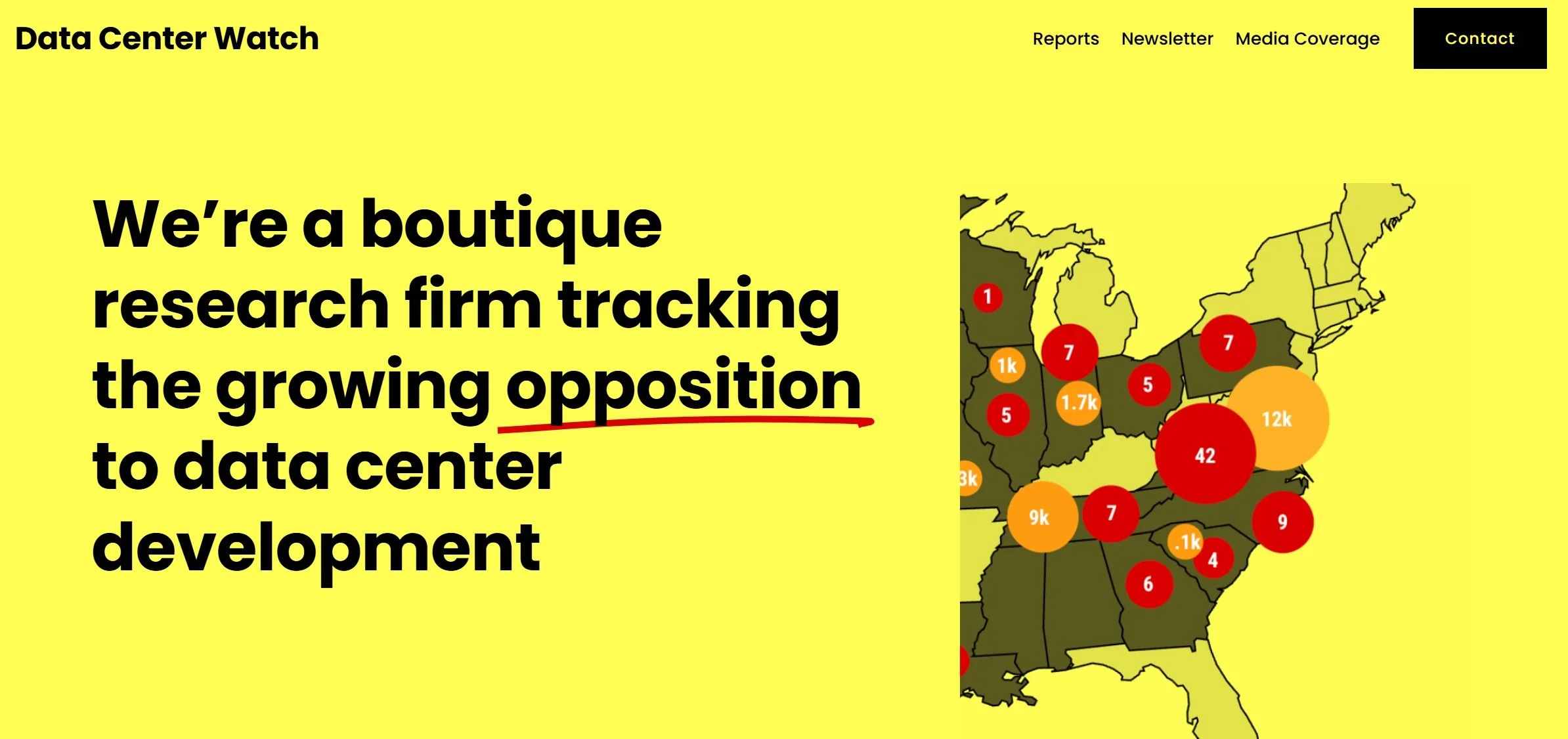
Main page of Data Center Watch’s website. Source: https://www.datacenterwatch.org/
It wasn’t until sometime after February of 2026 that Data Center Watch finally updated their About Us section to reflect who they really are: “a research project from 10a Labs.”
This change came long after several media outlets had revealed the company behind the website. Wired ran multiple articles, in June and November 2025, linking Data Center Watch to 10a Labs, as did numerous other news outlets. So it’s quite suspicious that they kept their ties to an AI security company hidden for so long.
Here’s what 10a Labs says they do:
“10a Labs is the safety and threat-intelligence layer trusted by frontier AI labs, AI unicorns, Fortune 10 companies, and leading global technology platforms. Our adversarial red teaming, model evaluations, and intelligence collection enable engineering, safety, and security teams to stay ahead of evolving threats and deploy AI systems safely.”
10a Labs has a financial incentive to create an atmosphere of fear – to make it seem like data centers are under constant threat from rabid activists that could cost them billions and billions of dollars. If we know this, we can use appropriate caution in reading Data Center Watch’s research reports. We can be suspicious.
This is why Data Center Watch hid who they are. And why 10a Labs created a front organization to publish their “research.” If 10a Labs released their findings that activists are derailing data center projects at an alarming rate, people would rightfully question their results and closely examine their methodology. But if a ragtag watch group doing research publishes the same findings, we might not be as cautious because we’re unaware there’s a significant conflict of interest involved.
Digging into the Research
So now that we know to be suspicious, let’s look at Data Center Watch’s first report:
Time frame: Right off the bat, I can’t find any solid information on what time period this study covers. The link to the report in their menu says “2023-Q1 2025” but it is never discussed or even mentioned in the report. There’s no explanation of how they chose the timeframe for the study, which means there is no discussion of what biases might be present by choosing this range of dates. Later in the report, they say that they have been tracking online petitions opposing data centers since 2022. Why are they including data center opposition for projects outside their timeframe?
Methodology: There is a methodology section, but it is only three sentences. The first says that they built “a database of activist activity and public officials involved in blocking or delaying development.” The second names a few types of sources. And that’s it. There is no detail as to how they actually collected their data or how they analyzed it. There is nothing here that can give us any trust that they haven’t just hand-picked cases that fit their narrative – and that’s a giant red flag. But what really disqualifies the findings of this report for me is this note that they include:
“This report highlights political risks and local opposition as frequent factors in data center project delays or cancellations, including community resistance, environmental concerns, and zoning issues. However, attributing delays exclusively to these factors oversimplifies a complex landscape.
Data center projects are influenced by multiple intertwined elements—regulatory compliance, infrastructure readiness, utility availability, economic incentives, and broader market dynamics. Each project's circumstances must be individually assessed to fully understand the combination of forces causing delays or obstructions.”
They fully understand that they can’t isolate the effect of activism on data center project outcomes – that would take proper research skills. And yet, they present their findings as having done so anyway. Their subheading on the report says that “local activism threatens to derail the U.S. data center boom,” even though they know they can’t make that claim.
Findings: I could write an entire paper on everything wrong with their findings, but I will spare you that and just highlight a couple issues.
They state that there are “at least 142 activist groups across 24 states organizing to block data center construction and expansion.” They don’t show any data. They don’t explain how they came up with those numbers. I do social movement research, in addition to studying front groups, and I can tell you that it is LABORIOUS to collect this type of data. They’ve provided nothing that makes me believe they did the work needed to get these numbers.
They indicate that “a review of public statements by elected officials in districts with large data center projects (50 MW>) under consideration found that 55% of the politicians who had taken public positions against the data center projects were Republicans, and 45% were Democrats.” Who did the review? When was it published? There are no citations for anything in this report – another giant red flag.
Perhaps the biggest issue is the data center projects themselves. I have little confidence that this is the full population of data center projects that were blocked or delayed during their nebulous time frame. Additionally, the report gives us no idea of what percentage of successful data center projects this subset represents. Their yellow map with the ominous orange and red circles certainly looks alarming, but we really have no idea how this compares to the number and cost of the data centers that were approved.
There’s also issues with double counting. For example, they count a project in Chesterton, IN as blocked and a project in Burns Harbor, IN as delayed. What they don’t tell us is that the projects are related: “On July 26, roughly six weeks after Provident withdrew its Chesterton proposal, neighboring Burns Harbor announced it had been approached by the company with a new plan.” Provident Realty shopped its project to multiple towns – they weren’t planning to build two different data centers. Which brings us to a related problem: companies building data centers will often hedge their bets and submit project plans to multiple locations. When a company withdraws its plans, it could be because another location was preferrable. But Data Center Watch gives the impression that all these withdrawals are due to activists.
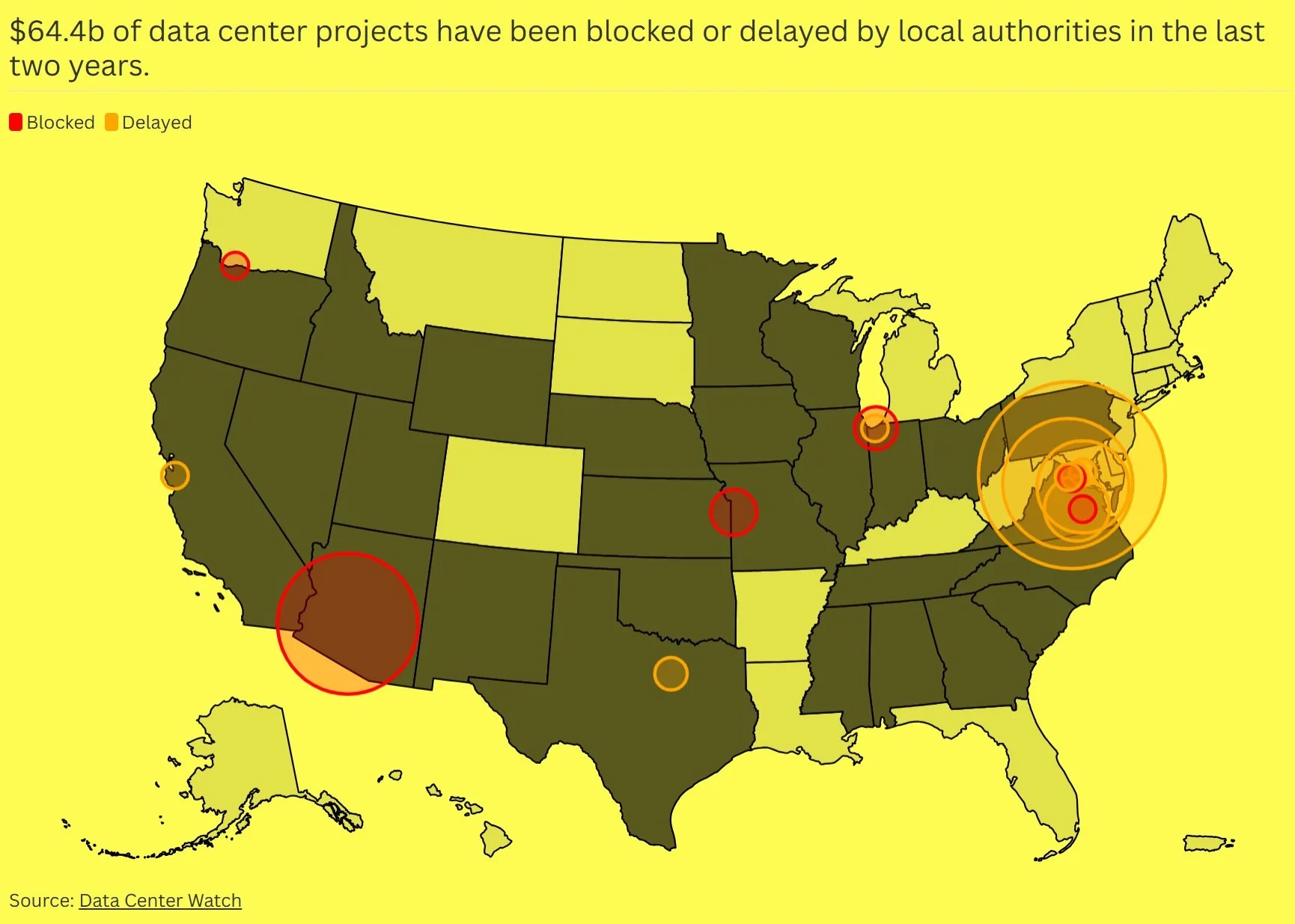
Map of data center projects that have been blocked or delayed, according to a report by Data Center Watch. Source https://www.datacenterwatch.org/report
The Big Picture
Using skewed “research” to create favorable regulatory, cultural, or business environments for themselves is a favored tactic of firms. Unfortunately, they’ve figured out that they can hide a study’s bias by having a third party present it – often a corporate front group. I’ll cover more examples of this in the future, including the tactic of using scientists-for-hire. In the meantime, whenever you see research from an organization you don’t know and trust, always ask yourself: Who benefits from this?
[i] https://web.archive.org/web/20250514100414/https://www.datacenterwatch.org/